
WP4 – Climate Optimized Flight Routes: Predictability and Costs
Work Packages
This WP will make contrail avoidance practical by improving weather forecasts and modeling tools, enabling reliable predictions of where warming contrails may form. It will also evaluate the trade-offs between climate benefit and operational cost, equipping airlines and air traffic managers with the tools needed for smart, climate-conscious flight planning.
Goal: Improve weather and contrail prediction tools and assess the climate benefit and cost of avoiding contrails.
How:
- Use better satellite and aircraft data to improve weather forecasts (especially humidity predictions).
- Develop ways to measure how reliable contrail predictions are.
- Compare fuel costs and climate impacts of different flight paths.
- Analyze 400 demonstration flights from WP3.
Why: So airlines can make smart choices: avoid warming contrails without wasting fuel or money — using reliable predictions and clear cost-benefit tools.
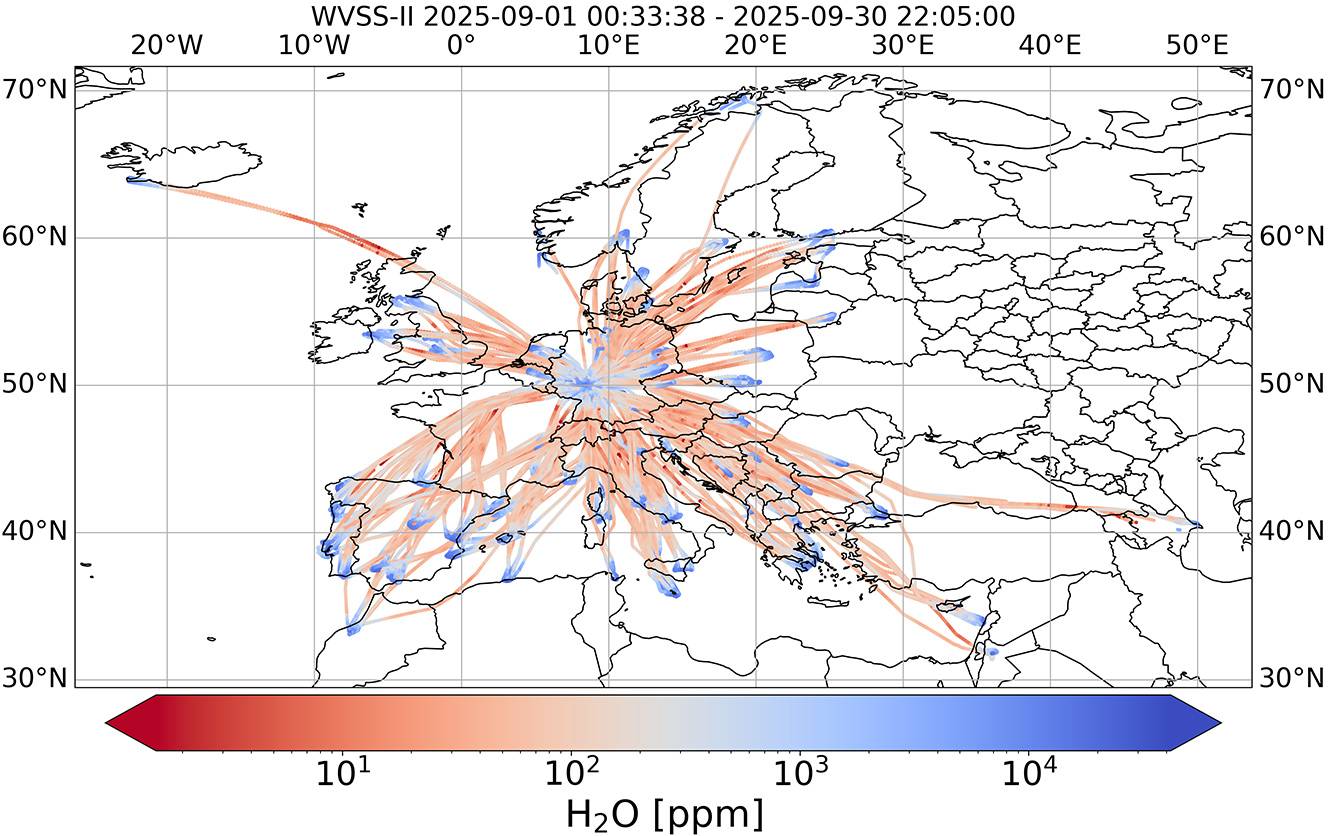
Credits: Mara Montag (JGU).
Key Technical activities:
- Evaluation of ICON Weather Model with Assimilated Observations (Task 4.1)
Using airborne and satellite observations (e.g. from Aerocloud mission), A4CLIMATE will assess the improvement in contrail-relevant forecast variables—particularly humidity—resulting from advanced data assimilation in the ICON model. - Assessment of RHi in ECMWF IFS Forecasts and Ensembles (Task 4.2)
The accuracy and uncertainty of ice supersaturation (ISSR) predictions using ECMWF’s IFS and ensemble forecasts will be analysed, validated against in-situ and lidar humidity observations. - Flow-dependent Analysis of Contrail Predictability (Task 4.3)
The spatial and dynamical dependence of ISSR predictability will be studied, linking atmospheric conditions (e.g. gravity waves, warm conveyor belts) to contrail formation accuracy using trajectory and ensemble data. - Climate and Cost Evaluation of Contrail Avoidance Flights (Task 4.4)
An analysis of >400 demonstration flights (WP3) will be completed, comparing climate-optimal vs cost-optimal routes in terms of energy forcing (EF), fuel burn, and operational costs using FK5D and CoCiP. - Impact of Climate Metrics (Task 4.5)
Different CO₂ equivalence metrics (e.g. GWP, GTP, ATR) and time horizons will be evaluated to assess how metric choice affects contrail avoidance decision-making and climate benefit quantification. - Comprehensive Assessment of Climate Impact and Predictability (Task 4.6)
DLR performs an integrated analysis of contrail energy forcing, forecast uncertainties, and cost-benefit trade-offs using CoCiP, ensemble forecasts, and satellite verification of actual flight outcomes.
Partners involved: Johannes Gutenberg University Mainz (JGU, Lead), German Weather Service (DWD), German Aerospace Center (DLR), ETH Zurich, University of Reading (UREAD), FLIGHTKEYS (FKY)